Two Controllers, One Sofa: The Living Room Games Making a Comeback
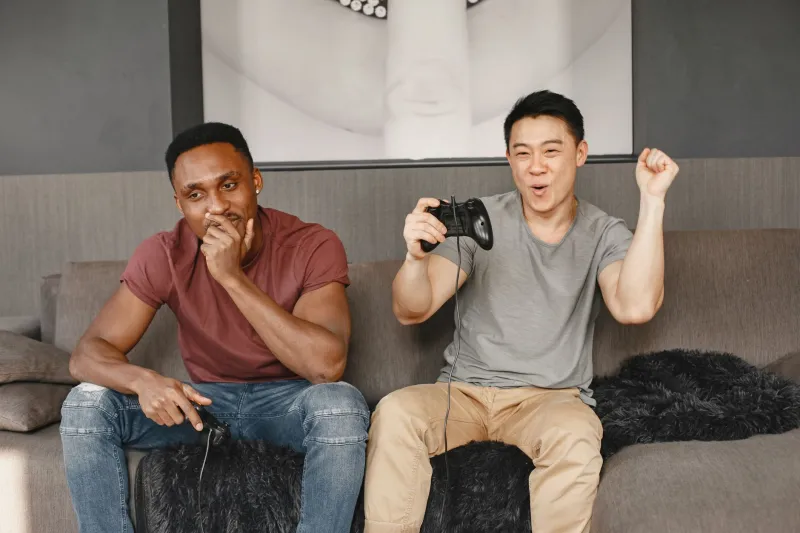
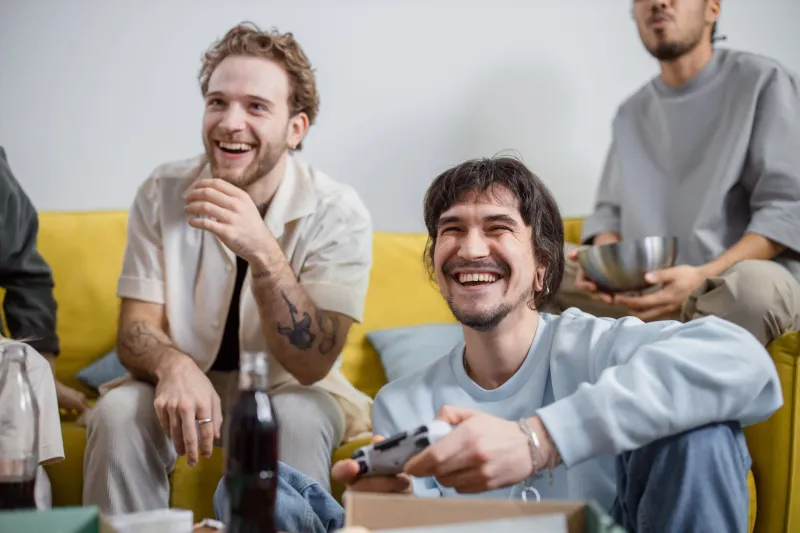
There's a moment in every living room gaming session that no online lobby can replicate. Someone's elbow is in your ribs. Someone's snack is dangerously close to your controller. And when the match ends, you can see — with your actual eyes — the face of the person who just beat you.
For most of the last decade, the industry treated that moment like a relic. Broadband was fast, matchmaking was smart, and sitting on the same couch started to feel like a workaround for people who hadn't figured out headsets yet. Online co-op became the default, and split-screen quietly got cut from sequel after sequel, usually with a shrug and a line about 'resource constraints.'
Then something funny happened. The games built around the sofa started outselling the ones built around the lobby.
The Numbers Nobody Planned For
Look at the sales charts over the last few years and a pattern emerges that no publisher roadmap predicted. It Takes Two — a game that is essentially unplayable without a second person in the room (or at least on a second screen share) — moved over 20 million copies. Overcooked, Gang Beasts, Untitled Goose Game, Move Out, Pico Park: these are all games whose core mechanic is proximity. You have to be able to yell at someone from three feet away.
Nintendo, meanwhile, never stopped believing. Mario Kart 8 Deluxe has spent what feels like a geological era on the bestseller lists, and a huge chunk of that is four-player split-screen on a console you can carry to a friend's apartment. The Switch didn't invent couch co-op's revival, but it gave it a home.
The market data backs up the anecdotes. Surveys of US gamers keep surfacing the same finding: a meaningful share of players — and notably, a majority of parents buying games for households with kids — say local multiplayer is a deciding factor in what they purchase. That's not nostalgia. That's a family with two kids and one console doing math.
What the Small Studios Know That Big Ones Forgot
I talked to developers at a few small studios working on local multiplayer projects, and the same themes kept coming up.
First: couch co-op is cheap to design for and brutal to get right. When both players share a screen, every camera decision, every UI element, every spawn point becomes a negotiation. 'Online hides your sins,' one designer told me. 'Split-screen puts every flaw two feet from someone's face.'
Second: the audience is different. Online multiplayer games live and die on retention metrics — daily logins, battle pass progress, the whole apparatus. Party games live on word of mouth. Someone brings Overcooked to a college dorm, and six weeks later twenty people have bought it. There's no subscription to cancel because there's no subscription. The game either makes your living room louder or it doesn't.
Third — and this is the part publishers undervalued — couch co-op has a ceiling problem and a floor problem, and the floor matters more. These games almost never become esports. But they almost never die, either. There's no server to shut down, no matchmaking population to starve. A split-screen game from 2010 works exactly as well today, which is more than you can say for a lot of 'live service' titles that are now unplayable doorstops.
What We Actually Lost
It's easy to be nostalgic about the couch era, and honestly, some of the nostalgia is earned. But it's worth being precise about what went away when gaming went fully online, because some of it wasn't the games. It was the logistics.
Online play made gaming more convenient and less social in the same stroke. You can play with your best friend every night without ever seeing them. That's a genuine gift — I know plenty of adults whose friendships survive on nightly lobbies across time zones. But it also meant gaming stopped being something you did with your body in a room. The 3 a.m. Discord call replaced the basement. For a lot of us, that trade was worth it. For some of us, it wasn't entirely.
There's also a generation issue here. A lot of today's parents grew up on GoldenEye, Halo LAN parties, and Mario Party friendships that ended over stolen stars. When they have kids, they're not looking for ranked lobbies. They're looking for the modern equivalent of the thing they remember — and the market noticed before the press releases did.
The Hardware Nobody Expected to Sell
Here's the strangest part of the revival: people are paying extra for it. Extra controllers. Second consoles for local wireless play. HDMI splitters and projector setups for Mario Kart nights. There's a whole cottage industry of US-based sellers doing brisk business in 'party game bundles' — four controllers, a charging dock, and a rotating shelf of co-op titles.
Think about what that means. In an era when the industry spent a decade consolidating around one player, one screen, one account, consumers are voluntarily spending money to add players instead of remove friction. That's not a nostalgia play. That's people telling companies, with their wallets, what the meeting rooms got wrong.
Not a Reversal — a Correction
To be clear, nobody's predicting the death of online play. Ranked lobbies, cross-platform matchmaking, and 200-person battle royales aren't going anywhere, and most of us wouldn't want them to.
What's happening is smaller and more interesting: the industry over-corrected. It treated the couch as an obstacle instead of a feature, and a wave of indie studios — plus one very stubborn Japanese company — proved there was still a market for games designed around the person next to you.
So the next time a trailer boasts about 'seamless online integration,' keep half an eye out for the smaller games promising something else entirely: a second controller, a full couch, and someone close enough to steal your stars.
Some technology goes away because it's obsolete. Some goes away because it's inconvenient. The couch, it turns out, was only the second kind.